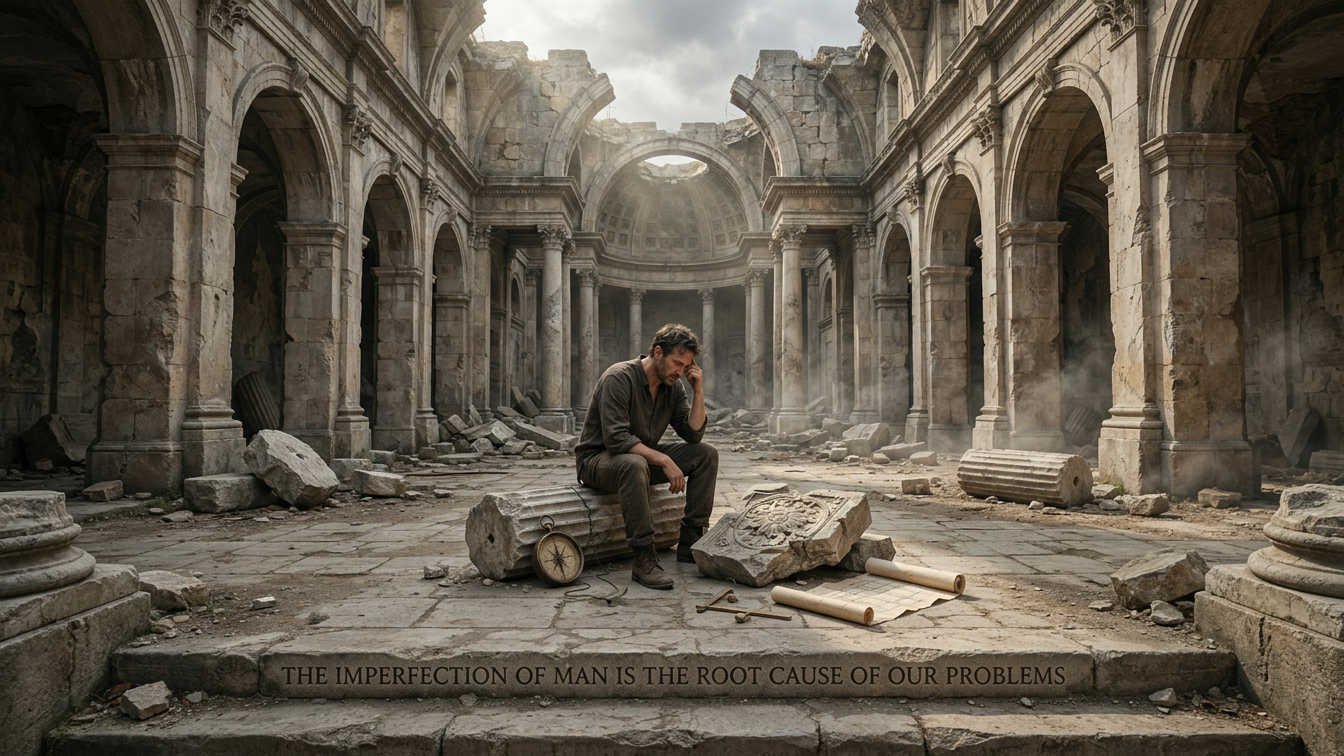
the Root of Our Problems
When you look around at the world today, what do you think is actually causing all our problems? You’ve probably noticed that a lot of issues are caused by situations that basically trap us. Even if people want things to change, they feel stuck. Everyone has to play by the rules of the current system.
Take farmers in developed countries, for example. To stay afloat, a farmer feels they have to use modern methods, which costs a fortune these days. Without making a massive profit, they can’t cover the high costs of equipment, fuel, and fertiliser. So, if demand for their crops drops, or they take a heavy hit from bad weather, they can’t pay for what they need to keep going. If they’re running on borrowed money, they could lose everything.
And how much can one farmer really do to help starving millions in today’s society? Right where they live, tonnes of meat might be sitting in cold storage with no buyers for their cattle or pigs. The farmer might desperately want that food to go to hungry people. Yet, to keep their farm running, they have to get paid for their livestock. They simply can’t afford to give it away for free.
Getting that meat to hungry people around the world isn’t simple either. Everyone involved in handling, processing, and shipping the food needs to get paid to make a living. Even if surplus meat were donated, shipped for free to areas hit by famine, and handed out, it still might not fix the issue. Why? Because eating meat, or certain types of it, might go against the local people’s religious beliefs.
Manufacturing is trapped in a similar system that relies on huge profits. Equipment, fuel, wages, raw materials, and upkeep require massive amounts of cash. To compete globally, companies have to keep prices as low as possible. Often, they can’t afford to spend big money on things that don’t make a profit—like cutting down on pollution. Some major companies would rather shut down a factory than spend millions to meet environmental rules.
People living near these industrial areas obviously want an end to the constant noise, smoke, and grime. Yet business owners ask, “What happens if we close the factories? Sure, pollution stops, but mass unemployment would ruin the local economy.” So, even though everyone knows the risks, heavy pollution just keeps going.
We could list plenty of other examples, and they all point to the same thing. Today, we’re dealing with the combined fallout of mistakes made by people, organisations, and countries over the centuries. The issues this system has created are worldwide and threaten our survival. Back in August 1974, at a major conference against nuclear weapons, a scientist named Dr Arthur Vance pointed out, “Human life is now threatened as never before, not by one but by many perils, each in itself capable of destroying us, but all interrelated, and all coming upon us together.”
Clearly, the whole system needs a total overhaul. However, making that happen would require massive sacrifices. Who could we actually trust to decide what gets sacrificed for the greater good? Who has the wisdom to manage things so everyone gets life’s basic necessities? With all the tribal, national, and racial divides out there, how could we be sure the people making the rules wouldn’t just rig things to benefit themselves, their families, friends, or their own country?
Even if we had a 100% guarantee of fair treatment for everyone, how many people would willingly take a pay cut, change their diet, and give up luxuries just to save strangers on the other side of the world from starving? How many would genuinely be happy with less and glad to help others out? And what about the people receiving the help? Would they actually be grateful, or would some get greedy and try to take more than their fair share at everyone else’s expense?
The system we have now didn’t just build itself. People are behind it. Doesn’t this show there’s a deeper flaw in human nature?
A Basic Reason—Human Imperfection
Even when people mean well, they constantly say and do things that hurt others. Time and again, we fall short of being the kind of people we want to be. You could say we keep missing the mark. Ancient languages actually used a word that literally meant “to miss the mark” to describe these failings, which is what many modern languages call “sin”.
Nobody is immune to flaws. We’ve all inherited weaknesses and imperfections. How did that happen, though? Despite years of research, scientists still can’t fully explain it. Even the root cause of physical decline during ageing remains a puzzle. A 1974 edition of a major encyclopaedia stated, “The basic biological causes of ageing are still unknown.”
Still, there’s an ancient text that explains where both our moral and physical flaws come from. Millions of thoughtful people feel this source offers a solid answer. It explains that through one man, imperfection entered the world, bringing death with it, and that spread to everyone because we all fall short.
That first couple, Adam and Eve, missed the mark by failing to stay completely loyal to their Creator. Once they lost that perfection, they could only pass on flaws to their kids. As a wise man from ancient times once asked, “Who can produce someone clean out of someone unclean? There isn’t one.”
However, inherited flaws don’t explain every single problem we face. After all, imperfect people are still capable of showing deep care for others. Plenty of people have even given their lives trying to save someone else. We constantly hear people begging leaders and nations to stop heading down paths that could lead to disaster. Yet the world still seems determined to act recklessly. Why is that?
Invisible, Powerful Spirit Influence
Could there be forces outside the human world pushing things in a bad direction? Plenty of people think so. Looking back at the horrors of the mid-twentieth century, a historian named Julian Ross said it felt as though “certain forces sprang out of the ground, a collective supra-personal force.”
Writing in a major Sunday magazine in February 1973, a commentator named Thomas Reid noted that modern atrocities are way out of proportion to normal human nastiness. He wrote, “The magnitude of the evil isn’t proportionate to the malice of the people involved. Many killers are men of moderate good will who intend not evil but good. Evil comes from mistakes, miscalculations, limitations, ignorance, far more frequently than it comes from malice.”
So who is pushing flawed humans toward acts of violence that go way beyond their natural instincts? People might sense some superhuman force at play, even if they can’t name it. Ancient writings, however, not only identify this force, but they also explain when and how it started meddling in human affairs.
According to these texts, intelligent spirit beings existed long before the earth was made. One of them decided to oppose the Creator and tried to take control over the first humans, and by extension, all of us. To pull this off, he told malicious lies about the Creator. Because of this, he later became known as the “Resister” and the “Slanderer”. At his urging, not only did the first humans rebel, but other spirit beings joined in too. These rebellious spirits eventually became known as “demons.”
These writings show that this Resister and his demons are behind a toxic attitude that sweeps through a world choosing to ignore higher moral laws. You can see how powerful a bad influence like this can be by looking at how a mob behaves. On their own, the people in a crowd might not be cruel or violent at all. They might usually be peaceful, decent folks. Yet once that mob mentality takes over, otherwise law-abiding citizens start acting completely unhinged, smashing property, attacking, and even killing others. Later on, many feel deeply ashamed and can barely believe what they did.
When you look at the terrible things humans do to each other, doesn’t it make sense that cruel spirits force are taking advantage of our natural flaws when we ignore moral boundaries? What else could explain the sheer scale of the horrors we’ve seen in the past and in modern times?
Lack of Proper Relationship with God
Human imperfection and the influence of these dark forces exist because humanity lost its close connection with the Creator. You can see solid proof of this whenever basic moral laws are ignored—problems just pile up. For instance, ancient wisdom strongly advises against sexual immorality. When people ignore that advice, we see spikes in sexually transmitted infections, unwanted pregnancies, broken homes, separations, and divorces.
Without higher guidance, humanity as a whole has basically been stumbling around in the dark. Even people genuinely trying to do the right thing are held back by their own flaws and the broken system around them.
What we really need is a way to get back on good terms with our Creator. We need to be freed from our inherited flaws and all the painful stuff that comes with them—sickness, ageing, and death. No person, group, or government can pull that off for us. Does that mean we’re completely out of luck, or is there a real way out of all these massive problems?