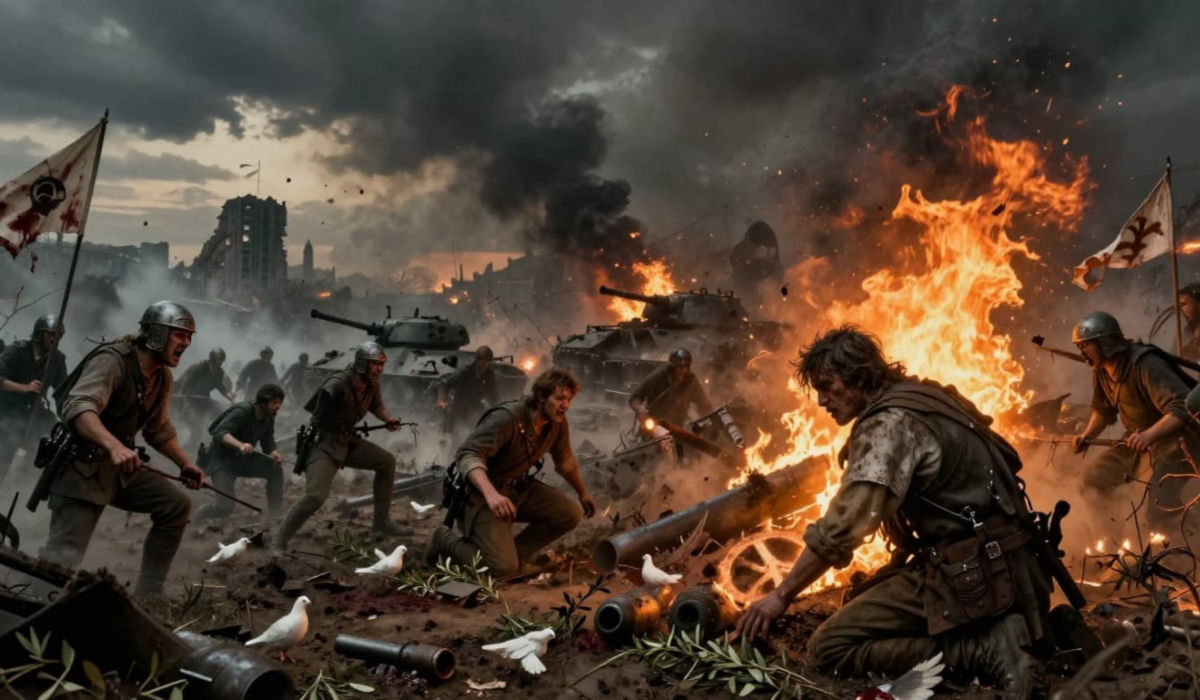
Is Man Incapable of Peace?
Global military expenditure hit a record $2.718 trillion in 2024. That total equals a 9.4% rise in real terms from 2023, and it is the sharpest year-on-year increase recorded since at least 1988.
Key details on global military spending in 2024
- Ten-year climb: 2024 marked the 10th straight year of growth. From 2015 to 2024, worldwide military spending rose by 37%.
- The biggest spenders, the United States, China, Russia, Germany, and India, made up 60% of the global total.
- United States, the US stayed far ahead, spending $997 billion in 2024.
- China ranked second with an estimated $314 billion in 2024, extending 30 years of continuous growth.
- Regional pressure points – the rise mainly links to the Russia-Ukraine war and conflicts across the Middle East.
- Nuclear weapons spending topped $100 billion in 2024.
Because of this, some conclude that humans are naturally violent and cannot live in peace. Yet peace is not beyond humans. Many people live quietly with others for long periods. For example, researchers have described small forest communities in the Philippines who had no history of organised killing or war. Also, Jehovah’s Witnesses live in many countries and do not take part in national conflicts. In one Catholic missionary journal in Portuguese, a nun wrote that the world would look very different if everyone refused to take up arms, whatever the cost, as Jehovah’s Witnesses do.
So peace is possible. Even so, war keeps returning.
Why War Keeps Happening
Most wars come with reasons that sound believable at the time. Borders and territory often spark disputes. Economic fears also play a major role. Japan’s push into Manchuria before the Second World War, for instance, was linked to trade pressures and rising protectionism during the global economic crisis. Nations felt boxed in, so they pushed outward.
Elsewhere, nationalism, prejudice, injustice, and poor communication have fed conflicts. At times, armies have also followed leaders driven by pride and personal fame, even when the human cost was clear.
The Bible points to a deeper cause. Weapons do not create war on their own; people do. When selfishness fills a heart, it spills into families, communities, and nations. If people replaced hatred, jealousy, and prejudice with love, compassion, and forgiveness, wars would lose their fuel.
“For example, out of the heart come wicked reasonings: murders, adulteries, sexual immorality.”
(Matthew 15-19)
These harmful traits are not part of how humans were made. The Bible says God created mankind upright, but people chose a different path and chased their own plans.
“This alone I have found: the true God made mankind upright, but they have sought out many schemes.”
(Ecclesiastes 7:29)
After humans turned away from God’s direction, selfish thinking took root. From there, anger, rivalry, and violence grew.
The Bible also describes another influence behind human conflict.
“We know that we originate with God, but the whole world is lying in the power of the wicked one.”
(1 John 5:19)

Since Satan the Devil was cast out of heaven down to earth, he has pushed people away from God’s rule. War serves that aim well. It hardens hearts, spreads fear, and rewards pride. It also makes it easier to shape public opinion towards hatred and revenge, which brings results that dishonour God.
A further issue is the lack of a truly effective world authority. A well-known science writer, Martin Ainsley, once argued that.
“… Real international co-operation would require a world government with power to make decisions and enforce them, leaving nations without the right to take up arms.”
Many look to the United Nations as that solution. Yet member states keep full national sovereignty. As a result, the organisation often functions as a place for debate, not a central authority. When member nations go to war, the UN may condemn it, but it often cannot stop it. It is not the world government needed for lasting peace.
Wars Recorded in the Bible
Some Bible accounts describe wars that appear to have had God’s approval. Those events reflect Jehovah’s authority as Universal Sovereign. As Judge of all the earth, he has the right to remove entrenched wickedness and violent corruption. At times, he used natural events, and at other times, he used nations as instruments of judgement.
“Will the Judge of all the earth not do what is right?”
(Genesis 18-25)
This is clear in the case of ancient Israel. They were instructed to remove certain Canaanite groups from the Promised Land. Moses stated the reason plainly.
“It is because of the wickedness of these nations that Jehovah is driving them away from before you.”
(Deuteronomy 9:4)
One Bible reference work, often called Harper’s Bible Guide, summarises the Canaanites as practising worship tied to sexual immorality and the sacrifice of children. Archaeology and ancient records have long supported the picture of a society marked by brutality. In that setting, the Bible presents Jehovah’s actions as judgement, not conquest for gain.
The Scriptures also point forward to a time when Jehovah will again assert his authority against those who violate his moral standards. The Bible presents that future action as necessary to end the cycle of violence and to protect those who want peace.
What Hope Exists for a War-Free World?
The Bible calls Jehovah “the God who gives peace”. Human efforts have repeatedly failed because they do not change what drives war from within. God’s approach begins with education, reshaping attitudes, motives, and habits.
The peace God offers is not based on fear, missile counts, or fragile treaties. It rests on people learning a different way of thinking. Governments have long trained children to serve national aims, including war. One former soldier from Japan, now one of Jehovah’s Witnesses, recalled how school lessons praised dying for the state and the emperor. In contrast, the Bible describes Jehovah teaching people peace.
“All your sons will be taught by Jehovah, and the peace of your sons will be abundant.”
(Isaiah 54:13)
Bible study has already helped many people change direction. One Japanese man, once a committed revolutionary, described how political writings and radical philosophies stirred his anger. He later joined an extremist group that sought violent revolution. Over time, he became sickened by internal fighting, the harm to bystanders, and the readiness to injure innocent people. After leaving that world, he began studying the Bible with Jehovah’s Witnesses. He found a sound basis for peace and a realistic hope for a better world. Today, he and his family spend many hours each month sharing that message with others.
Many thinkers have recognised that lasting peace needs a central world government that people accept. The Bible book of Daniel describes such a government, established by Jehovah, replacing all divided human rule.
“In the days of those kings the God of heaven will set up a kingdom that will never be destroyed. And this kingdom will not be passed on to any other people. It will crush and put an end to all these kingdoms, and it alone will stand forever.”
(Daniel 2-4 4)
According to the Bible, that government will remove the causes of war. It will end weapons and military training.
It will also unite people, removing barriers that keep nations separated and hostile. The Scriptures describe one pure language for all, which would remove a long-standing obstacle to peace. Most importantly, it will restore peace between humans and their Creator, and it will heal the mind and heart, which are essential for lasting peace.

A realistic objection remains. Some people will refuse to cooperate, even in a peaceful world. The Bible does not ignore that risk. It shows that Jehovah will give people time to learn and respond, but he will remove those who persist in rebellion. That step protects the peace of those who want to live by God’s standards.
“Just a little while longer, and the wicked will be no more; you will look at where they were, and they will not be there. But the meek will possess the earth, and they will find exquisite delight in the abundance of peace.”
(Psalm 37:10-11)
The Bible also urges people to make a choice, because peace requires willing support for God’s direction.
“I do take the heavens and the earth as witnesses against you today that I have put life and death before you, the blessing and the curse; and you must choose life so that you may live, you and your descendants.”
(Deuteronomy 30:19)
The hope held out in Scripture is not a fantasy. It is presented as a certain outcome of God’s purpose. Each of us decides whether we will submit to that purpose and support the way of peace.