

donald trump
45th US president from 2017 to 2021 – 2024 to present.
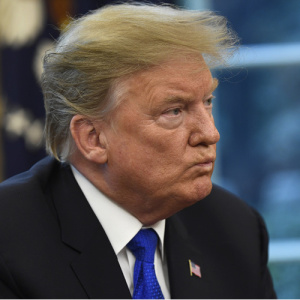
Just two and a half months into his presidency, Donald Trump had already set a brutal tone. Under his administration, US strikes killed high numbers of civilians, in ways that critics say breach both US law and international law.
Killing civilians in unusually high numbers
Civilian deaths began over inaugural weekend. Two drone strikes in Yemen reportedly killed 10 people. One strike hit three people riding a motorcycle. Another strike hit seven people travelling in a car. Neither Trump nor Defence Secretary James Mattis said they approved the strikes. At the same time, the chain of authorisation remained unclear.
A week after taking office, Trump spoke about the death of a US Navy SEAL in a failed raid he had ordered in southern Yemen. However, he did not acknowledge the reported 30 people killed in the same operation, including at least 10 women and children. Airstrikes also damaged a health facility, a school, and a mosque.
Over the following month, reports linked the US-led coalition to a sharp rise in civilian casualties.
Airwars, an NGO that tracks reported harm to civilians from airstrikes in the Middle East, said almost 1,000 non-combatant deaths were alleged from coalition actions across Iraq and Syria in March, a record claim. The group added that these reported levels resembled some of the worst periods of Russian activity in Syria.
Airwars also said US aircraft accounted for most of the reported casualties attributed to coalition strikes. As a result, the organisation said it would reduce work on alleged Russian actions in Syria so it could focus limited resources on monitoring and assessing reported casualties from the US and its allies.
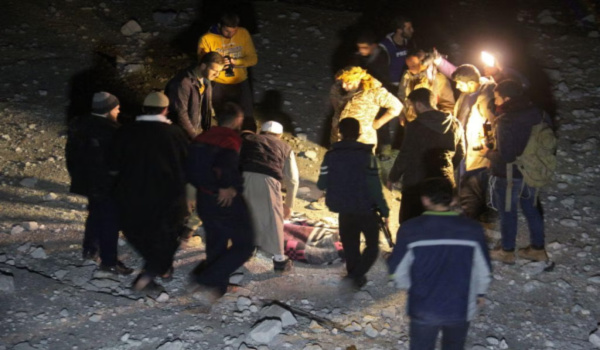
In the latter part of March, several incidents drew intense scrutiny.
- US drones struck a mosque in Aleppo, Syria, reportedly killing at least 47 civilians.
- US aircraft hit homes, a school, and a hospital in Tabqah, Syria, reportedly killing 20 civilians.
- A US-led coalition strike hit a school sheltering 50 displaced families near Raqqa, Syria, reportedly killing at least 33 civilians.
- A US airstrike in Mosul, Iraq, killed more than 200 people, the largest reported civilian death toll since the United States began bombing ISIS in Syria and Iraq in 2014. US defence officials said approval came from within the Middle East command structure, likely from a one-star general or a team working under that officer.
A Mosul resident, Abu Ayman, described flattened houses and severed limbs in the streets. He said he and others rescued three people from a neighbour’s home, but at least 27 others in the same house died, including women and children who had fled from other districts. He said they used hammers and shovels to move debris, but many remained buried under collapsed roofs.
Another Mosul resident summed up the fear in the city, saying it felt as if the coalition was killing more people than ISIS.
Chris Woods, the director of Airwars, told the Washington Post that casualty reports from western Mosul were shocking. He said patterns in Syria often involved a car here and a family there, happening day after day.
Reports also raised alarms about certain munitions. Observers documented the coalition’s use of white phosphorus in Mosul, a substance that can cause severe burns. In addition, US Central Command confirmed it used depleted uranium against ISIS in Syria, which critics argue may amount to a war crime.
Coalition airstrikes and alleged breaches of US law
Like the two administrations before it, the Trump administration justified armed drones and other targeted killings by citing the Authorization for the Use of Military Force (AUMF). Congress passed the AUMF days after the attacks of 11 September 2001. It authorised the president to use force against groups and countries that supported those attacks. However, Congress rejected a request for open-ended authority to deter and pre-empt any future acts of terrorism or aggression against the United States.
Critics say deterrence and pre-emption describe what Trump pursued through strikes on suspected militants, and on people present in areas deemed suspicious.
In 2013, the Obama administration issued Presidential Policy Guidance for targeted killing outside areas of active hostilities. The guidance allowed targeting of a person who posed a continuing, imminent threat, not only to US people, but also to people in another country.
A Department of Justice white paper from 2011, leaked in 2013, argued a US citizen could be killed even without clear evidence that a specific attack on US people and interests would occur in the immediate future. That position weakened the meaning of an imminent threat test. Critics argue the bar would be even lower for non-citizens.
The guidance also required near certainty that an identified high-value target, or another lawful terrorist target, was present before lethal force. Yet, as under Obama, the Trump administration likely relied on signature strikes. These do not always focus on named people. Instead, they can treat patterns of behaviour, and all military-age males nearby, as grounds for a strike.
In addition, the guidance required near certainty that non-combatants would not be injured or killed. Given the volume of reported civilian deaths from drones and other strikes, critics say the Trump administration did not appear to meet that standard.
At the same time, the Pentagon pushed to expand what counted as the battlefield beyond Iraq, Afghanistan, and Syria. Under that approach, other designated countries would no longer be treated as outside areas of active hostilities. As a result, the civilian protection threshold would drop from near certainty to reasonable certainty. Observers warned that this shift would likely drive up civilian casualties.
Trump designated three areas in Yemen as areas of active hostilities, sometimes described as temporary battlefields. Reports also said Somalia would soon receive the same designation.
In parallel, the National Security Council considered whether to scrap the Obama-era guidance entirely. That could remove the continuing and imminent threat test. Another proposal reportedly considered narrowing the near certainty standard so it applied only to women and children, not to men of military age.
Trump also granted the CIA broader power to carry out lethal drone attacks. Obama had largely confined that authority to the Defence Department’s Joint Special Operations Command. Unlike the Pentagon, the CIA does not have to report how many people a strike kills.
In mid-March, 37 former government officials and national security experts from across the political spectrum wrote to Defence Secretary James Mattis. They urged caution in any review of the targeted killing rules. The letter warned that even small numbers of unintended civilian deaths or injuries can cause serious setbacks.
Still, whatever rules the administration chooses, international humanitarian law continues to apply.
Coalition airstrikes and alleged breaches of international law
Under Article 51 of the United Nations Charter, self-defence is a narrow exception to the ban on the use of force. States may act in people or collective self-defence only in response to an armed attack. If the United States claims the right to kill suspected terrorists, or their allies, before they act, critics say it must meet a strict standard. Under the Caroline Case, self-defence must be necessary, instant, overwhelming, leaving no choice of means and no moment for deliberation. Critics argue Trump’s targeted killings do not meet this threshold.
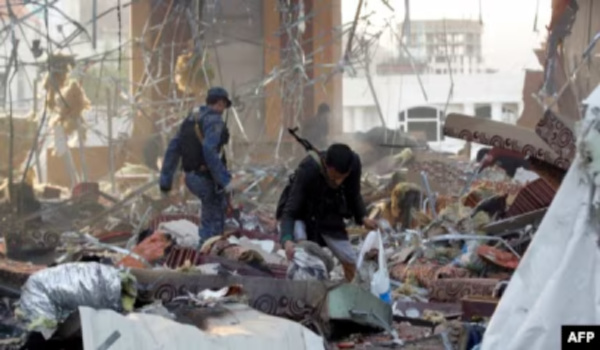
Outside active battlefields, drone attacks also raise long-standing legal concerns. Targeted killings, sometimes described as political assassinations or extra-judicial executions, may breach the Geneva Conventions. The Conventions treat wilful killing as a grave breach. Under the US War Crimes Act, grave breaches can be punished as war crimes.
The United States has ratified the International Covenant on Civil and Political Rights. It states that every human being has the inherent right to life, protected by law, and that no one shall be arbitrarily deprived of life. It also protects rights such as the presumption of innocence and a fair trial before an impartial tribunal. Critics argue targeted killings bypass these safeguards.
International humanitarian law also requires proportionality and distinction, as set out in the First Protocol Additional to the Geneva Conventions.
Proportionality means an attack cannot be excessive when weighed against the expected military advantage. Critics say the administration used drones to hit convoys and other targets, while civilian deaths rose far beyond the number of militants targeted.
Distinction requires attacks to focus only on legitimate military objectives. Yet reports describe strikes on places with no clear military function, including hospitals, schools, mosques, and passenger ferries. If signature strikes continued, bombs would also fall on unidentified people in areas judged suspicious.
The Rome Statute of the International Criminal Court lists war crimes that include wilful killing, causing great suffering or serious injury, intentionally attacking civilians or civilian objects, and launching unjustified attacks while knowing they will kill or injure civilians.
On this view, coalition bombings of schools, hospitals, homes, and mosques, with heavy civilian death tolls, meet the definition of war crimes.
Mosul Eye, a monitoring group, warned Iraqi troops that civilians were trapped in homes days before the Mosul airstrike. It reportedly sent the coordinates. Amnesty International concluded the US-led coalition should have known its airstrikes would cause many civilian casualties, because authorities told people to remain in their homes.
Amnesty International said the coalition did not take enough precautions to reduce harm to civilians in Mosul, calling it a flagrant violation of international humanitarian law. The organisation added that disproportionate and indiscriminate attacks violate international humanitarian law and can amount to war crimes.
Trump escalates in the Middle East
At the same time, the US military planned to send an extra 1,000 troops to northern Syria. Around 500 US Special Operations forces were already there, alongside 200 Marines and 250 Rangers.
Reports also said the administration intended to lift troop caps set under Obama, including 5,000 in Iraq and 500 in Syria.
Trump asked Congress to add $54 billion a year to the military budget. He framed the request as part of a public safety and national security budget.
Trump also refused to rule out nuclear weapons in the so-called war on terror. In an interview on MSNBC, he suggested that if ISIS attacked the United States, a nuclear response could be considered.
He also said he would consider killing the families of suspected terrorists. Targeting civilians breaches the Geneva Conventions.
Taken together, these shifts pointed to looser rules of engagement and a higher risk of civilian deaths. Critics argued that would deepen violations of US law and international law.
Under the doctrine of command responsibility, commanders can be liable for war crimes if they knew, or should have known, subordinates would commit them and did nothing to stop or prevent them. This principle appears in Supreme Court case law and in the US Army Field Manual.
On that basis, critics say Trump and senior officials in his administration should face accountability for war crimes.