something from nothing?


Which makes more sense​—that everything came from nothing or that everything came from something or someone?

Every morning brings a quiet miracle. Deep within the sun, hydrogen atoms fuse into helium under extreme heat—millions of degrees. From this fusion, violent X-rays and gamma rays burst outward. If the sun were transparent, these rays would reach us in seconds. But instead, they bounce through dense layers of solar matter, gradually losing energy. Thousands of years later, this once-deadly radiation emerges as soft yellow light—perfect for warming our planet.

Every night is miraculous too. Stars scattered across our galaxy shine in a dazzling array of colours, sizes, and temperatures. Some are supergiants so vast that, placed where our sun is, their surface would engulf Earth. Others are tiny white dwarfs—smaller than Earth but as heavy as the sun. Some stars will endure for billions of years. Others teeter on the edge of supernova explosions, destined to vanish in a flash that outshines entire galaxies.

Ancient cultures imagined sea monsters, gods in battle, dragons, turtles, elephants, and lotus flowers. Later, the Age of Reason replaced myth with mathematics—calculus and Newton’s laws. Today, the poetic legends are gone. In their place, the atomic age offers a new symbol of creation: the bomb. The modern origin story is an explosion. It’s called the Big Bang.

What the Big Bang “Explains”

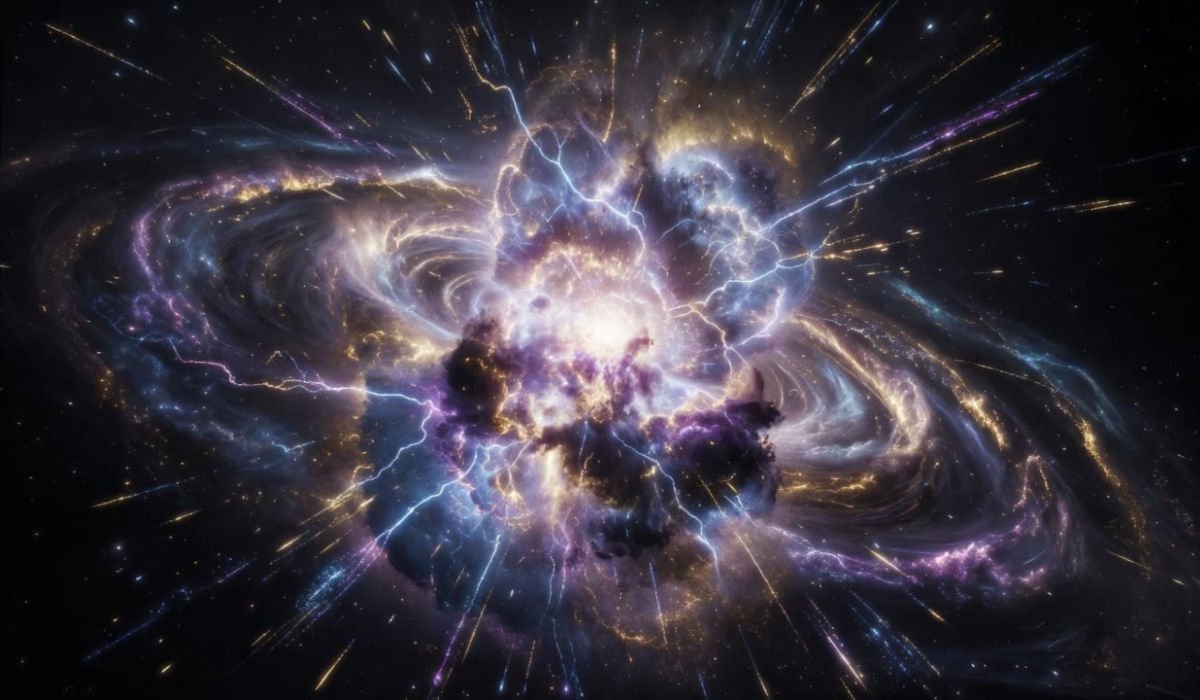
According to the most accepted version of this theory, around 15 to 20 billion years ago, there was no universe—no space, no time, no matter. Just a singularity: an infinitely dense, infinitesimally small point. Then it exploded. In the first fraction of a second, the universe expanded faster than light.

During the first few minutes, nuclear fusion occurred on a cosmic scale, producing hydrogen, helium, and some lithium. After about 300,000 years, the fireball cooled enough for electrons to settle into atoms, releasing a flash of light. That ancient light is still detectable today as microwave background radiation at 2.7 Kelvin. Its discovery in the 1960s convinced many scientists that the Big Bang theory had merit. The theory also explains why galaxies appear to be racing away from each other—the universe is expanding.

But despite its explanatory validity, the theory leaves many questions unanswered.

What the Big Bang Doesn’t Explain

History offers a cautionary tale. The astronomer Ptolemy once theorised that planets orbited Earth in complex loops called epicycles. His model seemed to work—until too much data made it unwieldy. Copernicus’s simpler idea, that Earth orbits the sun, eventually replaced it.

Fred Hoyle, in The Intelligent Universe, compared efforts to patch the big bang theory to Ptolemy’s epicycles. He wrote:

“The main efforts of investigators have been in papering over contradictions in the Big Bang theory to build up an idea which has become ever more complex and cumbersome.”
“A sickly pall now hangs over the big bang theory… When a pattern of facts becomes set against a theory, experience shows that it rarely recovers.”
Page 186, New Scientist, 1990:

“The antiquated method has been lavishly applied to… the big bang cosmological model.”
“We must be more honest and forthright about the purely speculative nature of some of our most cherished assumptions.”

Questions the Big Bang Cannot Answer

New data from the Hubble Space Telescope has shaken the theory. Astronomer Wendy Freedman measured a galaxy in Virgo and found the universe may be expanding faster than thought—suggesting it’s only about eight billion years old. But some stars appear to be 14 billion years old. If true, those stars would be older than the Big Bang itself.

Hubble Space Telescope
The Hubble Space Telescope

Other discoveries add to the puzzle. Astronomers have found vast “bubbles” in space—100 million light-years wide—with galaxies on the edges and voids inside. Geller and Huchra discovered a “great wall” of galaxies stretching 500 million light-years. The Seven Samurai group identified the “Great Attractor”, a massive gravitational anomaly pulling galaxies—including ours—toward it. Postman and Lauer suspect something even larger beyond Orion, drawing galaxies like rafts on a cosmic river.

This structure is hard to reconcile with the theory. The Big Bang was supposedly smooth and uniform. So how did such massive, tangled formations arise?

The Scientific American publication admits:

“The latest crop of walls and attractors intensifies the mystery of how so much structure could have formed within the 15-billion-year age of the universe.”

“We Are Missing Some Fundamental Element”

Geller’s 3D maps of galactic clusters have reshaped our view of the cosmos. But she remains puzzled:

“I often feel we are missing some fundamental element in our attempts to understand this structure.”
“We clearly do not know how to make large structures in the context of the Big Bang.”
“Someday we may find that we haven’t been putting the pieces together in the right way, and when we do, it will seem so obvious that we’ll wonder why we hadn’t thought of it much sooner.”

Then there’s the biggest question: What caused the Big Bang?

Andrei Linde, a pioneer of the inflationary big bang model, admits:

“The first, and main, problem is the very existence of the big bang… What came before? If space-time did not exist then, how could everything appear from nothing?… Explaining this initial singularity… remains the most intractable problem of modern cosmology.”

Discover magazine concluded:

“Not a single cosmologist {worth their salt} would claim that the Big Bang is the ultimate theory of our’ ‘coming into existence.”

Next clear night, step outside and gaze at the stars. Their beauty and mystery remain untouched by theory.