the true meaning of christmas
The Bible makes no mention of the date of Jesus’ birth, nor does it instruct believers to commemorate it annually. As the respected theological reference work McClintock and Strong’s Cyclopaedia plainly observes… “The observance of Christmas is not of divine appointment, nor is it of New Testament origin.”
When the history of Christmas is examined honestly, what surfaces is not a story of holy devotion but one of cultural absorption — pagan religious rites quietly dressed in Christian clothing. Scripture itself warns that worshipping God in ways he has not sanctioned is not neutral territory. As the account in Exodus makes clear, even well-intentioned worship offered on unauthorised terms draws divine disapproval.
Did Early Christians Actually Celebrate Jesus’ Birthday?
The short answer is no — and the historical record is unambiguous on this point. Far from being an ancient Christian tradition, the celebration of Jesus’ birth was entirely absent from the early church. Historians of religion have noted that the first followers of Christ deliberately avoided birthday commemorations of any kind, viewing them as customs belonging to the pagan world rather than to the community of believers. As one major encyclopaedia of world history and culture put it… “The early Christians did not celebrate his birth because they considered the celebration of anyone’s birth to be a pagan custom.” The tradition, in other words, did not emerge from within Christianity. It was imported into it.
Why the 25th of December?
There is no credible historical or scriptural evidence placing the birth of Jesus on the 25th of December. No gospel account, no early church record, no contemporaneous document supports the date. What historians have long argued instead is that early church leaders selected this particular day with deliberate strategic intent — choosing it to align with and gradually absorb the pagan festivals already being observed across the Roman world at the time of the winter solstice. The date was not a discovery. It was a decision — one made for cultural and political reasons that had little to do with honouring the life of Jesus of Nazareth.
Feasting, Gift-Giving, and the Shadow of Saturnalia
The festive customs most associated with Christmas — the elaborate meals, the exchange of gifts, the candles and the revelry — did not originate in Bethlehem. They originated in Rome. The Saturnalia was a mid-December Roman festival of considerable scale and exuberance, and its influence on what would later become Christmas is extensively documented. As one major American encyclopaedia of history and culture records… “Saturnalia, a Roman feast celebrated in mid-December, provided the model for many of the merry-making customs of Christmas. From this celebration, for example, were derived the elaborate feasting, the giving of gifts, and the burning of candles.” A separate leading reference work adds that during the Saturnalia… “all work and business were suspended” — a social suspension that maps remarkably closely onto the modern experience of the Christmas period.
Christmas Lights and the Battle Against Darkness
The tradition of illuminating homes with lights during the midwinter season predates Christianity by centuries. Across pre-Christian Europe, communities would adorn their dwellings with candles and burning torches as the days grew shortest, seeking both to celebrate the solstice and to ward off the evil spirits believed to grow stronger in the darkness of winter. According to a leading encyclopaedia of world religions… “Europeans decorated their homes with lights and evergreens of all kinds” in observance of these ancient rituals. The warm glow of Christmas lights, so widely experienced today as a symbol of comfort and festivity, carries within it the memory of a far older and very different set of beliefs.
Mistletoe, Holly, and the Old Religion
The greenery that adorns so many homes each December has its roots not in any biblical tradition but in the nature worship of pre-Christian Europe. Mistletoe held a position of particular sacred significance among the Druids, who attributed to it extraordinary magical and healing properties. The holly, with its ability to remain green through the harshest winter months, was venerated as a living sign of the sun’s eventual return. As one historical encyclopaedia documents… “The Druids ascribed magical properties to the mistletoe in particular. The evergreen holly was worshipped as a promise of the sun’s return.” These were not decorative choices. They were acts of religious devotion to forces that had nothing to do with the God of the Bible.
The Christmas Tree and the Worship of the Forest
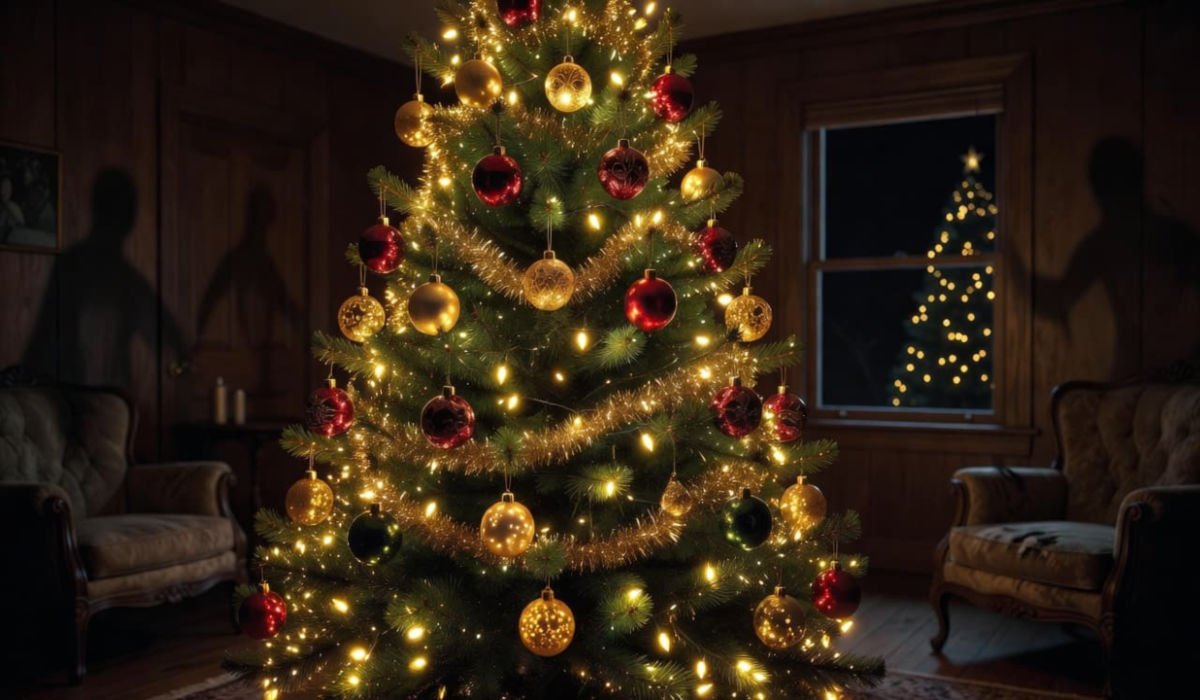
Perhaps no Christmas tradition makes the pagan inheritance more visible than the decorated tree brought indoors each December. Tree worship was widespread across pre-Christian European cultures, and the reverence with which certain trees — particularly evergreens — were regarded did not simply vanish when those cultures adopted Christianity. It survived, adapted, and found new expression. As a leading world encyclopaedia of history records… “Tree worship, common among the pagan Europeans, survived after their conversion to Christianity” — persisting most visibly in the custom of “placing a Yule tree at an entrance or inside the house in the midwinter holidays.” The Christmas tree is, at its origin, not a Christian symbol at all. It is a relic of a much older world, one in which the forest itself was considered sacred.
The question that all of this history quietly poses is not whether Christmas is enjoyable — clearly, for hundreds of millions of people, it is. The deeper question is whether enjoyment and meaning are the same thing, and whether a celebration built on foundations this far removed from its stated purpose can truly honour what it claims to. That is a question each person must ultimately answer for themselves.