mans rule about to collapse

empty gestures

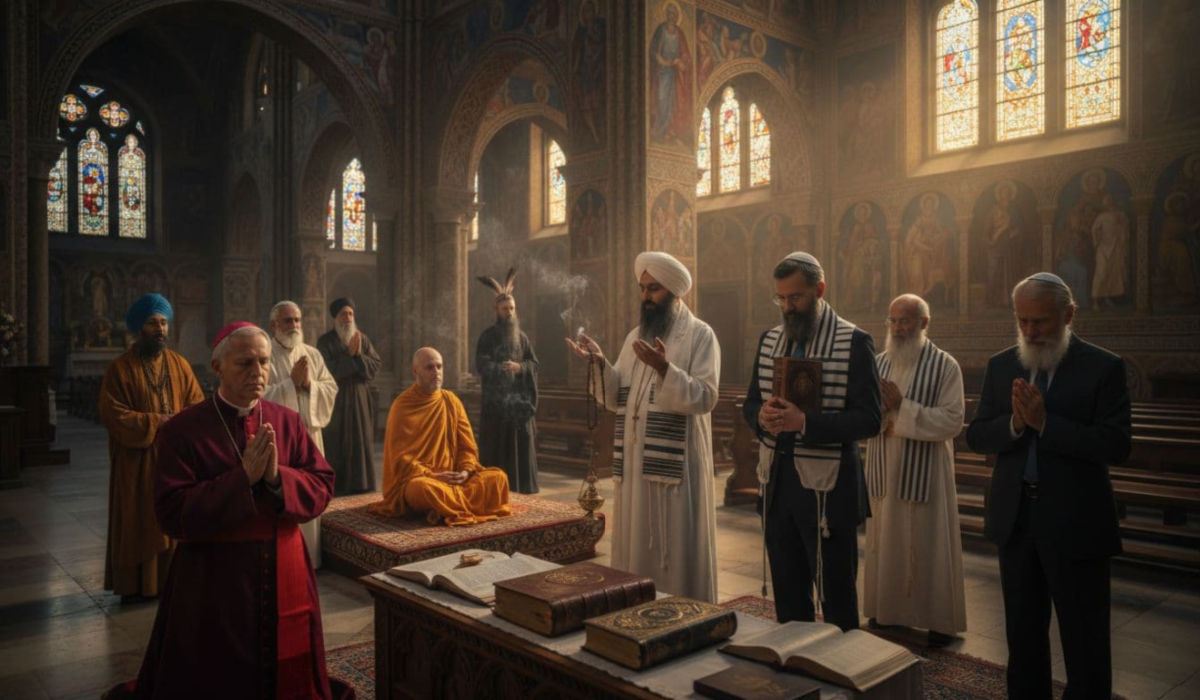
On 24 January 2002, leaders from all religions met in Assisi to pray for peace after the 11 September attacks. Pope John Paul II had called the meeting, as he had in 1986 and 1993. Christians, Muslims, Jews, Hindus, Buddhists, Sikhs, and others took part, while journalists and officials watched closely.

A Day of Prayer and Public Declarations

The leaders travelled from the Vatican to Assisi under heavy security. In a large marquee, delegates gave short statements against war, hatred, and terrorism. Several even admitted that religion often caused conflict.

Some of the strongest words came in brief public appeals.

  • A Catholic speaker said, ‘Only peace is holy, war is never holy!’
  • A Protestant delegate warned that faith should never lead to hatred.
  • Others said peace needs justice, respect, and love for one’s neighbour.

Afterwards, each faith group prayed separately, following its own rites in different parts of the town.

A Shared Pledge, and Doubts

Later, the delegations returned and made a common pledge for peace. The pope closed the day with the appeal,

‘Violence never again! War never again! Terrorism never again!’

Pope John Paul II

The gathering ended with public signs of peace and wide media praise.

Still, many critics weren’t convinced. Earlier meetings hadn’t stopped violence in places such as the former Yugoslavia, Pakistan, Indonesia, the Middle East, and Northern Ireland. Some called the event symbolic but very weak unless real action followed.

The Hard Question

Assisi showed that many religions can speak against violence together. Yet it also exposed a deeper problem. Religious leaders often call for peace, but their traditions have also been used to support division and war.

For that reason, the meeting left an uneasy question behind. Fine words were spoken, but many people still waited to see whether deeds would match them.
Similar Posts

  • ignore the bible at your own risk

    Consider this striking experience—a man in New York said, “I used to teach Sunday school in the Presbyterian church. After spending some time studying the Bible with Jehovah’s Witnesses, I approached my minister with questions about teachings like the Trinity. To my surprise, he couldn’t answer a single one of them from the Bible. He…

  • government corruption

    The UK recorded its lowest position yet in Transparency International’s Corruption Perceptions Index, falling to 20th place in 2023. This drop points to rising concern about political misconduct, lobbying, and conflicts of interest. Common complaints include cronyism, such as the award of COVID-19 contracts and public roles to political allies, as well as undue influence…

  • chance or intention?

    Many people believe that life originated from chance alone (the big bang) or through a chain of unguided events (evolution). This article takes a different view. It presents a Christian belief that God created the world and human life and that it is not a summary of scientific accepted opinion. Modern culture often treats random…

  • paying through the nose

    Judging whether petrol retailers are “profiteering” requires a close look at fuel margins and how quickly changes in wholesale costs reach drivers at the pump, while ministers and motoring groups often point to high forecourt prices as proof of “rip-offs”, official reviews and industry findings usually show a more mixed picture Evidence used to support…

  • out of control?

    The Damage of Living for Now Impatience and the hunger for quick pleasure have harmed modern life on every side. People exploit the earth for short-term gain, even when the long-term harm is plain to see. Economies do much the same, piling up debt to meet today’s wants while pushing the cost into the future….

  • UN success?

    The United Nations (UN) has a mixed record. It has achieved real success in humanitarian aid and peacekeeping, yet its failures are also serious and well documented. Critics often highlight its inability to stop mass atrocities, the deadlock within the Security Council, and scandals involving staff as some of its deepest weaknesses. Major historical failures…